If you picture Hollis, NH as a place of tight subdivisions and compact lots, you may be surprised. Hollis is better understood as a low-density New England town where space, privacy, and detached homes shape the market. If you are trying to figure out what kinds of homes and lots you are most likely to find here, this guide will help you narrow your search and set realistic expectations. Let’s dive in.
Hollis Home Styles at a Glance
Hollis has a clear housing identity. According to the town’s Comprehensive Plan, the community emphasizes preserving its rural and historic character, with a landscape defined by hills, farms, woodlands, meadows, and home sites.
That broader setting matters when you shop for a home. Hollis is not a compact suburban market. It is a town where single-family detached homes are the norm, and where lot size and natural surroundings often play just as big a role as square footage.
A useful summary is this: in Hollis, you are most likely to see older homes and antique properties near the village core, newer Colonials and Capes in subdivisions, and acreage or wooded lots throughout much of town. That pattern lines up with local planning documents, historic district information, and zoning rules.
Historic Homes Near the Village Core
If you are drawn to character, Hollis Village is the place to start. The Hollis Village Historic District covers roughly 400 acres, is centered on Monument Square, and is mostly residential.
Homes in this area are typically 1.5 to 2.5 stories and wood-frame in construction. The district includes a range of documented architectural styles, including Georgian, Federal, Greek Revival, Colonial Revival, Craftsman Bungalow, and Foursquare.
This part of town feels historic, but not densely urban. The district description notes open agricultural fields around the village center, which helps explain why even central Hollis can still feel semi-rural.
For buyers, that means village-area homes may offer:
- Traditional New England architecture
- Older construction details and historic charm
- A setting closer to the town center
- Larger open surroundings than you might expect in a historic core
Town Center zoning also supports single-family and two-family dwellings in parts of the historic area, along with conversion of certain pre-1952 residential buildings, based on the 2025 zoning ordinance. If you are considering an older property, zoning and condition are both worth reviewing early.
Colonials and Capes Across Town
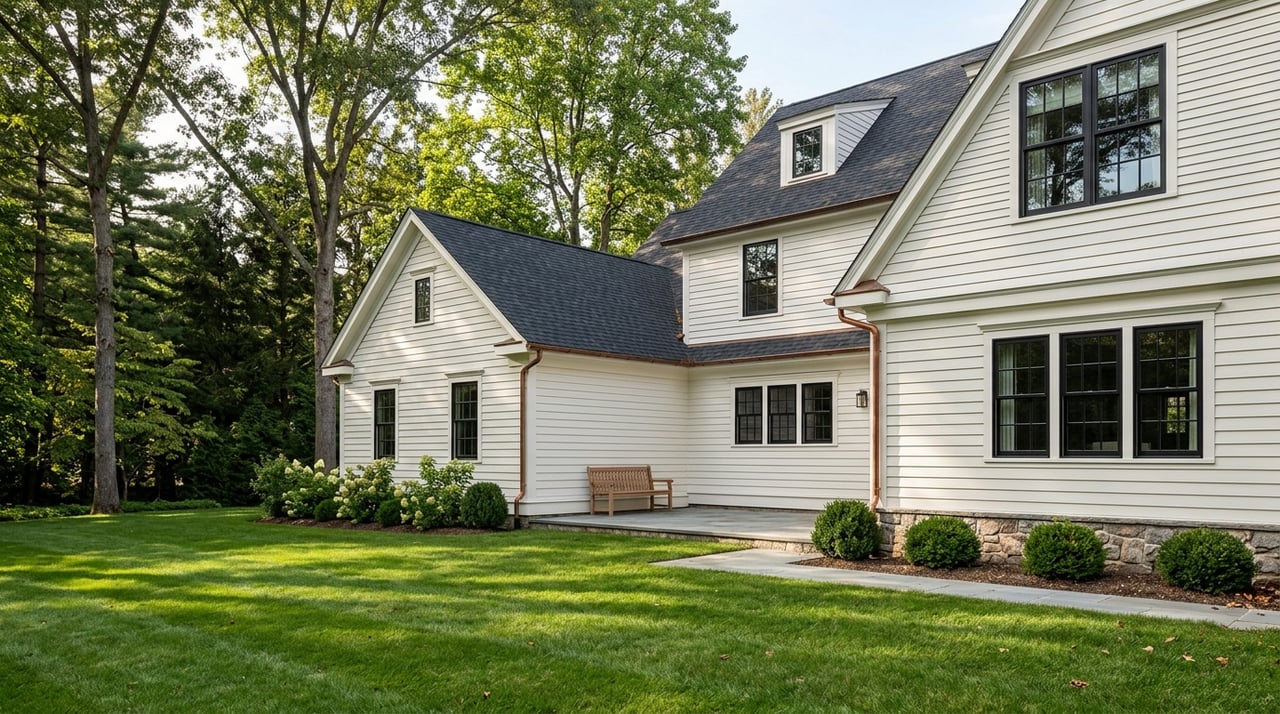
Outside the historic center, Hollis buyers will often encounter more traditional resale patterns. The practical style mix points strongly toward Colonials, modified Capes, and other traditional New England single-family homes, along with some newer custom homes and occasional renovated antique farmhouses.
This fits the town’s overall housing pattern. A past local hazard plan described development in Hollis as spread throughout town rather than clustered, with newer subdivisions generally built on about one-acre lots at that time, according to the 2012 Hollis Hazard Mitigation Plan.
That history still shapes how the market feels today. Even when you are looking at a neighborhood setting, the home style often leans classic and the lot still tends to offer breathing room.
Lot Types You Are Most Likely to Find
In Hollis, lot type is one of the biggest parts of the buying decision. The town’s zoning ordinance gives a strong clue about what to expect, especially if you are comparing Hollis with more compact nearby communities.
In the Rural Lands and Water Supply Conservation zones, the zoning ordinance requires a minimum lot area of 2 acres per dwelling and minimum frontage of 200 feet. Backland lots require 4 acres and some frontage on a public road.
Those standards reinforce the low-density feel many buyers notice right away. In practical terms, Hollis often appeals to people looking for privacy, separation from neighbors, and a more natural setting.
Village and Common Settings
Some homes sit closer to the historic center and common areas. These properties may offer easier access to the village core while still maintaining the open, agricultural surroundings that make Hollis distinct.
If you like a more classic New England streetscape and want proximity to historic character, this setting may be the best fit.
Wooded and Conservation-Adjacent Lots
This is one of the defining lot types in Hollis. Many buyers are drawn to wooded acreage, homes near protected land, and properties where the natural setting is part of the appeal.
Because zoning in much of town favors larger lots, these homes often provide a stronger sense of privacy than what you would find in a denser suburban market.
Planned-Development Neighborhoods
Hollis also has planned developments designed to preserve open space. Under Hollis Open Space Planned Development rules, individual lots can be reduced to 1 acre, but the overall project still cannot exceed 1 dwelling per 2 acres, and 40% to 50% of the tract must remain protected open space, according to the town’s zoning ordinance.
That means even smaller-lot neighborhoods in Hollis are generally intended to feel low-density. If you want a neighborhood environment without giving up the town’s rural character, this can be an appealing middle ground.
What Hollis Feels Like as a Buyer
The simplest way to understand Hollis is that it is a space-and-privacy market. The town’s housing pattern is spread out, owner-occupied, and centered on detached homes rather than multi-unit density.
According to U.S. Census QuickFacts for Hollis, the owner-occupied housing rate is 91.7%, and the median value of owner-occupied homes is $675,900 for 2020 to 2024. Those numbers are well above the state median and help explain why Hollis often attracts buyers looking for long-term ownership, more land, and a distinct sense of place.
For you as a buyer, this usually means:
- Detached homes are the standard
- Larger lots are common
- Privacy is often part of the value proposition
- Historic character is available, especially near the village core
- Planned neighborhoods still tend to preserve meaningful open space
How Hollis Compares With Nearby Towns
If you are also considering nearby towns, price and lot character may help you decide. According to Census QuickFacts, Hollis has a higher median owner-occupied home value than both Brookline and Amherst.
Here is the comparison:
| Town | Median Owner-Occupied Home Value |
|---|---|
| Hollis | $675,900 |
| Brookline | $544,400 |
| Amherst | $537,600 |
| New Hampshire | $402,500 |
In practical terms, Hollis often commands a premium for acreage, privacy, and historic character. Nearby towns may offer somewhat lower entry points and a somewhat broader mix of lot sizes.
That does not make Hollis better for every buyer. It simply means you should be clear on what matters most to you. If you value land, low-density surroundings, and traditional New England housing styles, Hollis stands out.
How to Choose the Right Home Style and Lot
The best fit usually comes down to how you want to live day to day. A beautiful home on the wrong lot can feel less useful than a simpler home in the right setting.
As you narrow your search in Hollis, think about these questions:
- Do you want historic character or newer construction?
- Would you rather be near the village core or farther out on acreage?
- Is privacy your top priority, or do you prefer a neighborhood setting?
- Are you comfortable maintaining more land?
- Would protected open space nearby add value to your lifestyle?
When you answer those questions first, the inventory tends to make more sense. You can quickly separate village homes, rural acreage properties, and planned-development neighborhoods based on what actually fits your goals.
Why Local Guidance Matters in Hollis
Hollis may look straightforward at first glance, but the details matter. Home style, zoning, lot frontage, age of construction, and setting can all shape value in very different ways from one property to the next.
That is especially true in a market where historic homes, larger parcels, and open-space design all show up in the same town. If you want to understand how one Hollis property compares with another, it helps to work with a team that knows how buyers weigh privacy, land, and character in this part of Southern New Hampshire.
If you are thinking about buying or selling in Hollis, Christensen Group, Inc. can help you understand the market, evaluate the tradeoffs between home styles and lot types, and move forward with a strategy built around your goals.
FAQs
What home styles are most common in Hollis, NH?
- In Hollis, you are most likely to find detached single-family homes, especially Colonials, modified Capes, antique homes, and older village properties with traditional New England architecture.
What are typical lot sizes in Hollis, NH?
- In many parts of Hollis, zoning requires at least 2 acres per dwelling, while some planned developments allow smaller individual lots if the overall project preserves substantial open space.
Are there historic homes in Hollis, NH?
- Yes. The Hollis Village Historic District includes older residential properties in styles such as Georgian, Federal, Greek Revival, Colonial Revival, Craftsman Bungalow, and Foursquare.
Do Hollis, NH neighborhoods have large yards?
- Many Hollis properties offer larger lots, wooded settings, or acreage because the town’s development pattern is generally low-density and spread out rather than compact.
Is Hollis, NH more expensive than nearby towns?
- Based on Census QuickFacts, Hollis has a higher median owner-occupied home value than nearby Brookline and Amherst, which often reflects its mix of privacy, land, and historic character.